
Green Township Previous Resident Sources
One address needs an era map before a search begins. The Hamilton County Recorder, Auditor, CHPL, and historical indexes each answer a different part of the question. A recorded deed can establish a dated transaction or ownership trail. A directory or census can place a person in a period, while a map helps test whether the address form existed then. None creates a complete list of everyone who lived at the address. Keep the source, date, legal description, and page or document reference together as the trail moves backward.
| Source | Years it covers | Where held | What it can show |
|---|---|---|---|
| Recorder FamilySearch indexes and selected deed books | 1794-1904; selected books 1877-1901 | Recorder FamilySearch route | Early deed-index and book leads after the right book and page are known |
| Historic Deed Indexes | 1914-1988 | Hamilton County Recorder | Grantor and grantee index references by year and surname initial |
| Acclaim recorded-document inquiry | From 1988 | Hamilton County Recorder | Name, date, document, book-page, legal-description, and Auditor-number routes |
| Directories and Criss-Cross material | City work from 1819; reverse address material from 1925 and called Criss-Cross by 1941 | CHPL collections | Dated person and address leads where the selected title covers the place |
| Federal census | 1790-1950 | CHPL and other census access routes | Household details for a date and enumeration geography |
For an early address, begin with the legal description and the correct township or municipality. For a later one, begin with the parcel and most recent transfer. CHPL identifies its online Auditor period as 1937 to present as a research aid, but date-specific transfers still need Recorder or ownership-card verification. A question about a person at an address needs the directory and census layers after the deed work, not in place of it.
Start Green Township Past Residents With a Parcel
The Hamilton County Auditor Property Search is the practical first stop for a known address. On its Street Address tab, enter the house number in House # Exact/Low and the base street name in Street Name. The form instructs users to omit the suffix. A low and high number can locate candidate parcels, but it does not create a resident list. Open the candidate card and preserve the parcel ID, situs address, legal description, current transfer details, and older transfer clues before opening the Recorder index.
Parcel and postal addressing can diverge, especially for multi-building arrangements or older address forms. The Auditor FAQ directs users to the Transfer tab for older transfer material and cautions that January 1 can be a filler date in older displays. A property card is organized around the taxable parcel. Owner or mailing fields, a transfer date, and a deed number are important trail markers, but they are not proof that every person associated with an address was there at the same time.
- Search the exact number and base street, then use a bounded number range only when an exact address does not resolve.
- Open the candidate parcel and record the parcel ID, situs address, legal description, tax district, and transfer clues.
- Compare the address with the property boundary if a postal form or unit arrangement is unclear.
- Carry the parcel number and legal description into the Recorder search rather than relying on a street label alone.
Follow Green Township Previous Resident Deeds
The Recorder's How to Search guide gives the right order: use the Auditor for owner, street address, or parcel ID; collect the current owner, sales date, legal description, and earlier transfer information; then use Recorder search by party, date, and document type. Acclaim provides the later recorded-document route, while Auditor number, subdivision-lot, and section-town-range forms are useful when a name is common or an old instrument uses a survey description.
- Find the most recent material transfer with the current parcel information and note the buyer, seller, recording date, document number, and legal description.
- Search the prior party with a sensible date range, then compare the document image and property description before accepting a name match.
- Use the seller as a lead to the earlier purchase, checking the party role instead of assuming every named party transferred the same parcel.
- Repeat the date, party, book-page, and legal-description checks for each link. Preserve alternate spellings as they appear.
- When the chain reaches a historic index or book-page reference, shift to the relevant historic route rather than treating a modern name search as complete.
- Grantor
- The party conveying an interest in a recorded document, commonly the seller in a deed transaction.
- Grantee
- The party receiving an interest in a recorded document, commonly the buyer in a deed transaction.
- Chain of title
- A sequence of recorded transfers tied to the same legal description. It is not a roster of past occupants.
- Legal description
- The lot, survey, subdivision, or other written land identifier that can remain useful when a street label changes.
Green Township Previous Resident Deeds Before 1988
The Recorder's Historic Deed Indexes cover grantor and grantee references for 1914 through 1988. The index locates a book and page. It is not the deed image and does not represent every property document. Use the year and surname initial to find the party, capture the party role and book-page reference, then inspect the associated material in context. For 1794 through 1904, the Recorder's FamilySearch guide identifies digitized deed indexes 1 through 21A and selected deed books. Its earlier-document route has free sign-in and access conditions, and images can be non-continuous.
This screenshot comes from the Hamilton County Recorder Historic Deed Indexes.
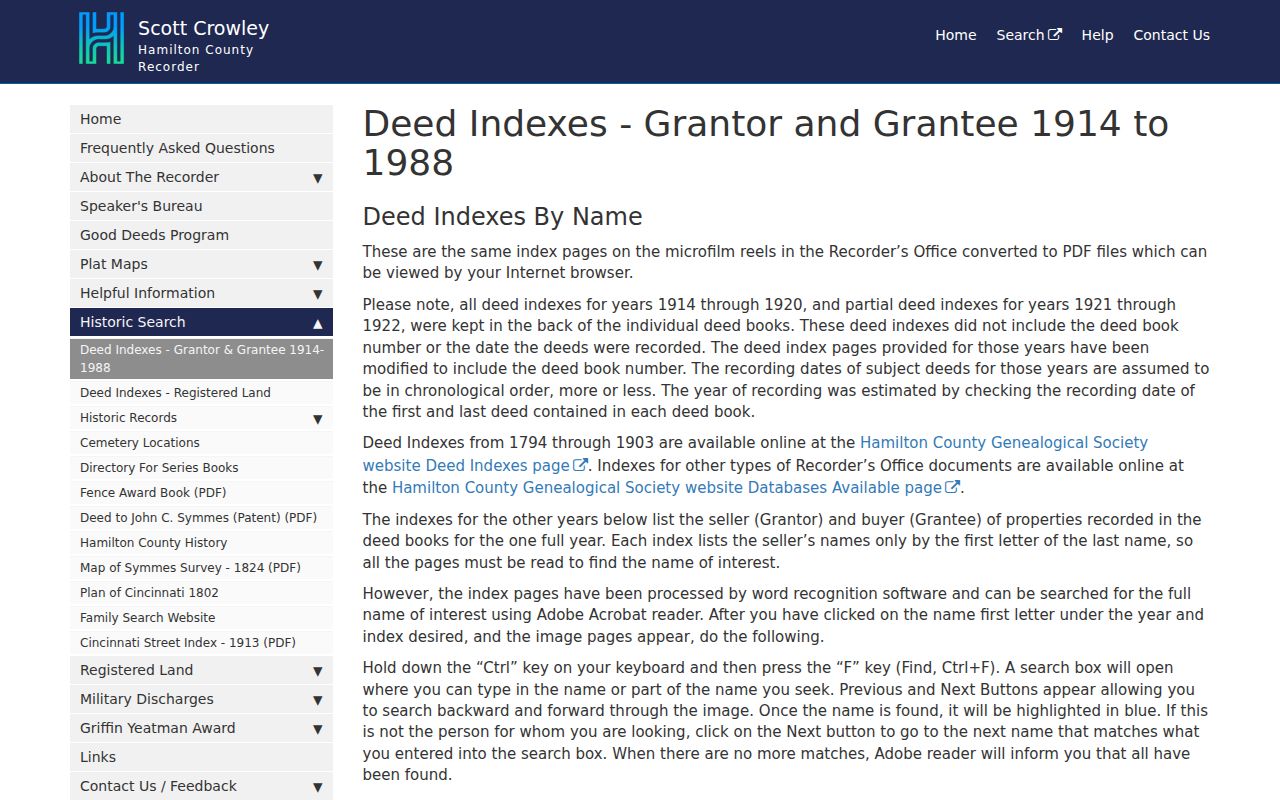
The index is a bridge. It turns a surname and year into a book-page trail that must still be checked against the parcel, legal description, instrument type, and surrounding transfers.
At the pre-mid-1988 boundary, the Recorder guide directs researchers to the historic book-page search. Older digitized images can be shifted by one or two pages, so move the image counter if the cited page does not line up. January 1 transfer dates can also be filler dates in old Auditor displays. Those two quirks are reasons to preserve the entire reference, not only a date copied from a search result.
Green Township Previous Residents by Address
A deed chain gives the recorded-property layer. A dated address directory can provide a separate historical person lead, if the selected volume covers the location. Pink Pages started in 1925, and CHPL says the material was called the Criss-Cross Directory by 1941. Search the street alphabetically and then the number in sequence, using the address form of the chosen year. The full collections and entry-reading rules are kept on the Green Township city directories page, so the address trail remains the focus here.
Pair each address entry with the closest census and map instead of assuming that a listed name represents an entire household. CHPL identifies census access from 1790 to 1950, while its historical newspaper sources include Newspaper Archive material from 1800 to 2019, a Cincinnati Post archive for 1882 to 2007, and Newsdex citations for local stories, death notices, and obituaries. A newspaper-index citation is a lead to the page, not the page itself. Check the date, place, and person before using it to close a past-resident trail.
- Record the directory title, year, page, exact address form, and the name as printed.
- Find the nearest available census and compare the township, community, ages, and household details.
- Use the legal description or parcel history to test whether the printed address still points to the same land.
- Check a newspaper, probate, or obituary lead for a dated event rather than treating the directory gap as an explanation.
Green Township Past Resident Census Endpoints
When an address trail reaches a death, estate, marriage, or obituary lead, use the custodian that holds that kind of record. Hamilton County Probate Court holds estates, guardianships, name changes, and marriage paths. Hamilton County Public Health issues many Ohio birth and death certificates, while the Ohio Department of Health Vital Statistics office is the state route. Ohio Revised Code 3705.23 generally calls for a signed application and fee for a certified birth or death record, with specific protections for adoption, medical or health data, and Social Security numbers.
The image below is from the Ohio History Connection death-record index source.
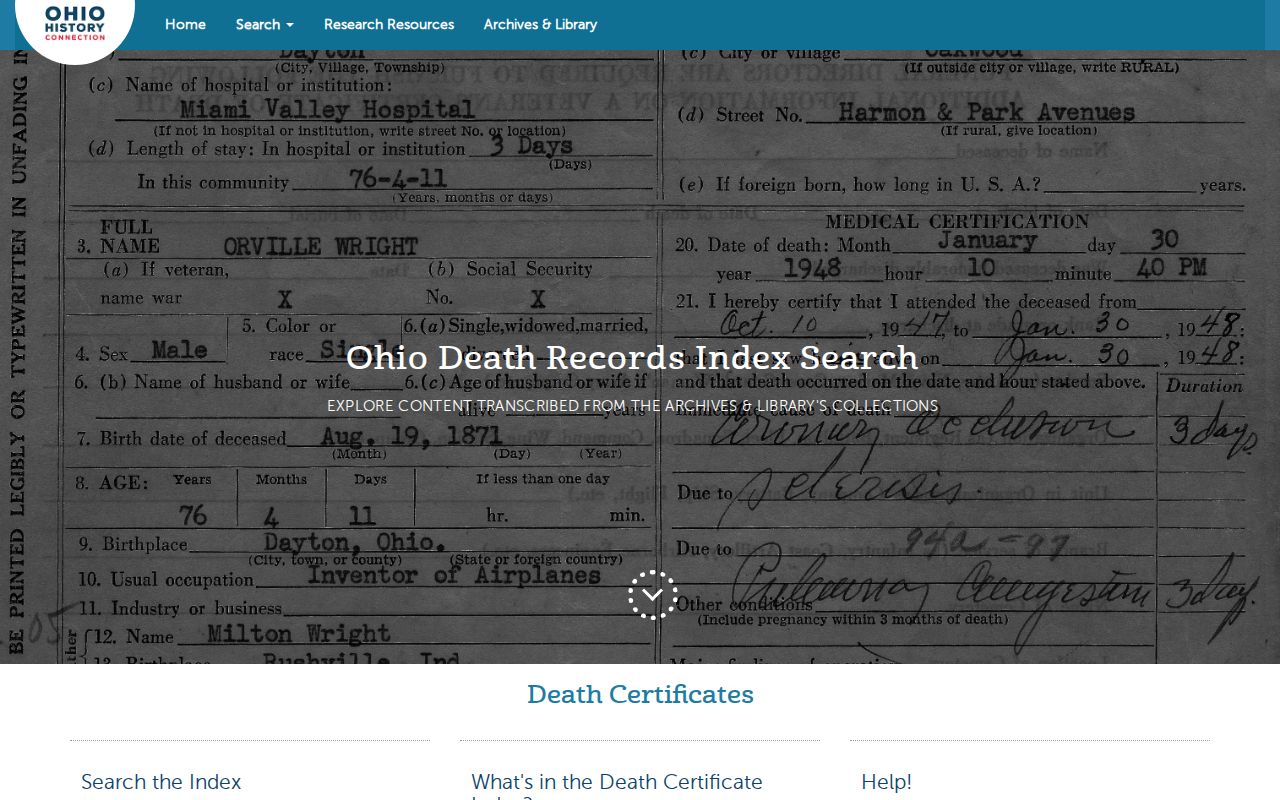
A historical index or certificate lead can help date the end of a trail. It does not independently establish that a person remained at a particular address until that date.
The following screen is from the Ohio Department of Health Vital Statistics office.
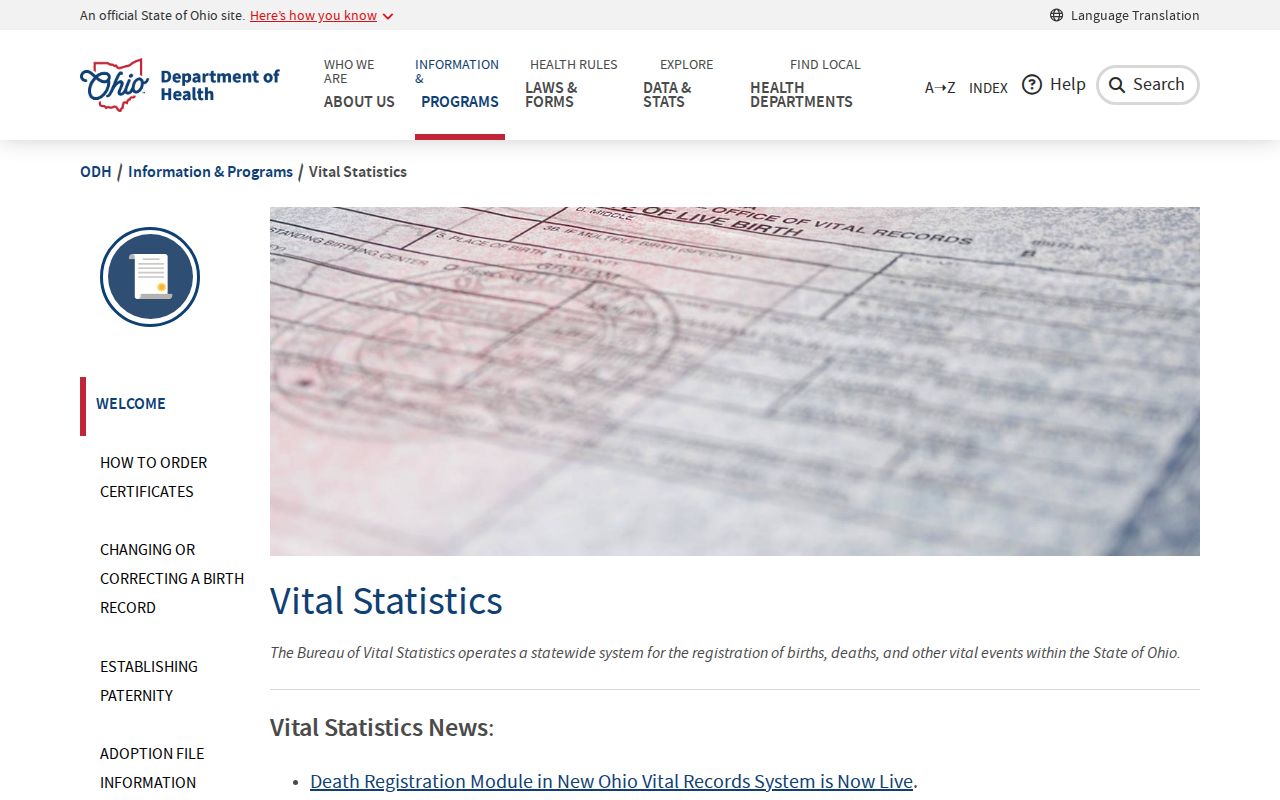
For a marriage path, the Hamilton County Probate Court marriage license page identifies the court's marriage role.

Marriage, probate, vital, and obituary material can corroborate a family connection or date. Each remains a separate record type with its own custodian and access rules.
Green Township Past Resident Place Names
Maps describe the setting of an address, not a person at it. CHPL's House History material points to Sanborn maps, the 1883 and 1884 Cincinnati Robinson Atlas, local photographs, and map-based address comparison. The first Cincinnati Sanborn maps are from 1891, and 1904 maps show newer address numbers. These are useful dates for the selected Cincinnati map sheet, not a claim that Green Township had complete map coverage in those years.
Use the Green Township history to keep place labels in their period. Westwood was annexed by Cincinnati in 1896, Beech Flats became Cheviot in 1900, and part of Covedale was annexed by Cincinnati in 1930. Mack also appears in older sources as Dry Ridge and Ebenezer. Monfort Heights derives from the Monfort Post Office, established around 1900, and the name was selected in 1926. These alternate labels may restore a catalogue or newspaper search, but they do not replace a legal description.
Note: Cincinnati's documented 1895 street renumbering is a Cincinnati instruction, not a blanket renumbering rule for Green Township roads.
Green Township Past Resident Property Records
A specific property-change record may date work at an address without identifying who lived there. The Township administers zoning in the Northeast Green Township or White Oak district. Elsewhere, it directs development applications to Hamilton County Planning & Development through ezTrak. The live ezTrak interface did not yield a stable public field, result, or historical-coverage inventory in the research, so it should not be described as a complete historic property search.
Road records have a separate split. The Township's right-of-way permit guidance distinguishes Township, county, and state roads. A qualifying Township permit costs $50, while the utility permit option has no charge. It also describes two inspections and 24-hour notice. Use the correct custodian with an address, approximate date, and defined record type. A released permit can date an apron, opening, or related project; it cannot establish the prior residents of the property.
Green Township Past Resident Limits
Past residents research is strongest as house history, family history, estate work, or personal curiosity. A parcel card and recorded deed identify parcel, tax, document, or ownership information. They do not prove every person who lived at the address. Directory coverage varies by year and geography, and a census belongs to its own enumeration date. Preserve those limits when describing a result, especially where a Cincinnati postal label, a changed community name, or an annexation can make one address appear under several place names.
Safe at Home participants, protected voter records, sealed or expunged court material, motor-vehicle restrictions, and redactions can limit public information. When a needed government record is identifiable but not available in an index, Ohio's Public Records Act, ORC 149.43, is the access fallback for a defined request to the office that keeps it. The office need not create an aggregate address history that it does not maintain.